‘Cry God for Harry, England and Saint George!’: Saint George in Late Medieval England

The twenty-third of April is the feast day of Saint George, patron saint of England.

English interest in St George arose in the fourteenth century under Edward III, who created the chivalric ‘Order of the Garter’ in his honour in 1348. The king’s special affinity with the military saint, and his notable success in the Scottish Wars of Independence and the Hundred Years’ War, may have helped to establish St George as the patron saint of England. Banners displaying St George’s arms (a red cross on a white background) were carried into battle at Halidon Hill (1333) for example, and, according to the fourteenth-century chronicler Jean Froissart, the English used the saint’s name as a battle cry before defeating the French at Poitiers (1356).

The Garter King of Arms Kneeling before St George in British Library MS Stowe 594, f. 5v.

The Garter King of Arms Kneeling before St George in British Library MS Stowe 594, f. 5v.

In the fifteenth century, Henry V’s personal devotion to St George continued to enhance English enthusiasm for the saint. In 1415, English soldiers carried banners depicting St George’s arms into battle against the French at Agincourt and emerged victorious. The saint’s feast day was declared a double holy-day and Archbishop Chicheley ordered that it should be kept as solemnly as Christmas, which meant, among other things, that people didn’t have to work.

By the late fifteenth century, St George was sufficiently aligned with military success, chivalry and national pride, for one chronicler to create a unique mythology for the arms, linking the best kings and knights from Britain’s legendary history with contemporary sovereigns and their chivalric orders.

Completed during the civil conflict known as the Wars of the Roses, the two chronicles composed by John Hardyng begin their account of St George’s ‘red cross’ with material adapted from the Vulgate Cycle of Arthurian romance. Hardyng explains that the ‘armes that we Seynt Georges calle’ originated with Joseph of Arimathea. Joseph is said to have given a shield to Evelac, pagan king of Sarras, upon his conversion, which bore a cross of blood in token of the blood spilt at Christ’s Crucifixion. The same device, we are told, was later adopted by the legendary Christian kings, Saint Lucius and Constantine the Great, by the Grail Knight Sir Galahad, who finds Evelac’s shield before achieving the Holy Grail, and by King Arthur, who is presented with a reliquary containing Galahad’s heart in the same way that the Emperor Sigismund presented Henry V with a reliquary containing St George’s heart in 1416.

St George Killing the Dragon in British Library MS Yates Thompson 3

St George Killing the Dragon in British Library MS Yates Thompson 3

Hardyng uses the continuity of the arms throughout the ages to connect the monarchs and knights from Britain’s past to the English kings and subjects who have fought under the saint’s banner in his own times. Attributing part of his information to an enigmatic prophet named Melkin associated with Glastonbury Grail lore, Hardyng claims that, long before St George was born, the arms were used to identify the British so that each man would be able to tell his countrymen from his enemies in battle:

These armes were vsed in alle Britayne
For comon signe, eche man to knowe his nacion
Fro his enmyes, whiche nowe we calle certayne
Saint Georges armes, by Mewyus informacion,
Ful long afore Saint George was generate
Were worshipt here of mykel elder date.

Elsewhere, he states that the arms are worshipped throughout the realm, especially by kings, who take them into battle and always emerge victorious. As a veteran of Agincourt, Hardyng doubtless had the victories of Henry V in mind and wanted to suggest that his glorious military success could be repeated again if his king (first Henry VI and later Edward IV) could bring an end to the civil conflicts plaguing contemporary Englishmen and reunite them against a common foreign enemy, such as Scotland or France.

St George in British Library MS Royal 2 A XVIII

St George in British Library MS Royal 2 A XVIII

In Hardyng’s history, the arms of St George are a rallying point for all loyal Englishmen, who are encouraged to support their king and emulate the Chronicle’s best proponents of chivalry. It is no coincidence that Hardyng ends the first version of his text with a eulogy for his former patron, Sir Robert Umfraville, a Knight of the Garter under the protection of St George, who is cast as the most courageous, kindest and just knight of his generation.

It is coincidental, but nevertheless fitting, that a century after Hardyng penned the last datable reference in his chronicles (1464), William Shakespeare, the author of the most famous quotation depicting Medieval England’s love affair with St George, is believed to have been born, and would later die, on the saint’s feast day: ‘Cry God for Harry, England and Saint George!’
'I am already sick of love': Medieval Valentines

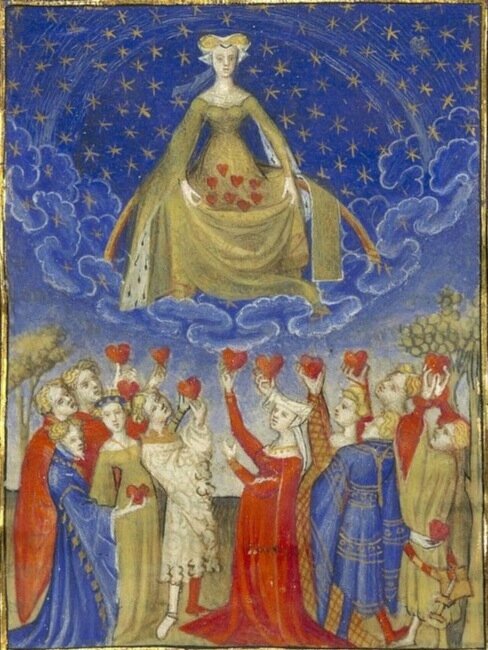
The earliest expressions of love linked to St Valentine’s Day are found in the Middle Ages. The most famous is Geoffrey Chaucer’s reference to Valentine’s Day in The Parliament of Fowls, which depicts birds choosing their mates on the feast day: ‘For this was on Seynt Valentynes day, Whan every foul cometh there to chese his make’ [For this was on Saint Valentine’s Day, when every bird comes to choose his mate, lines 309-10]. Less well-known is the fact that several of Chaucer’s contemporaries – Otton de Grandson, John Gower, Sir John Clanvowe, Christine de Pisan and John Lydgate – also wrote about Valentine’s day and helped to further its connection with romantic love.

Venus collecting medieval hearts in Bibliothèque nationale de France, Français 606.

Venus collecting medieval hearts in Bibliothèque nationale de France, Français 606.

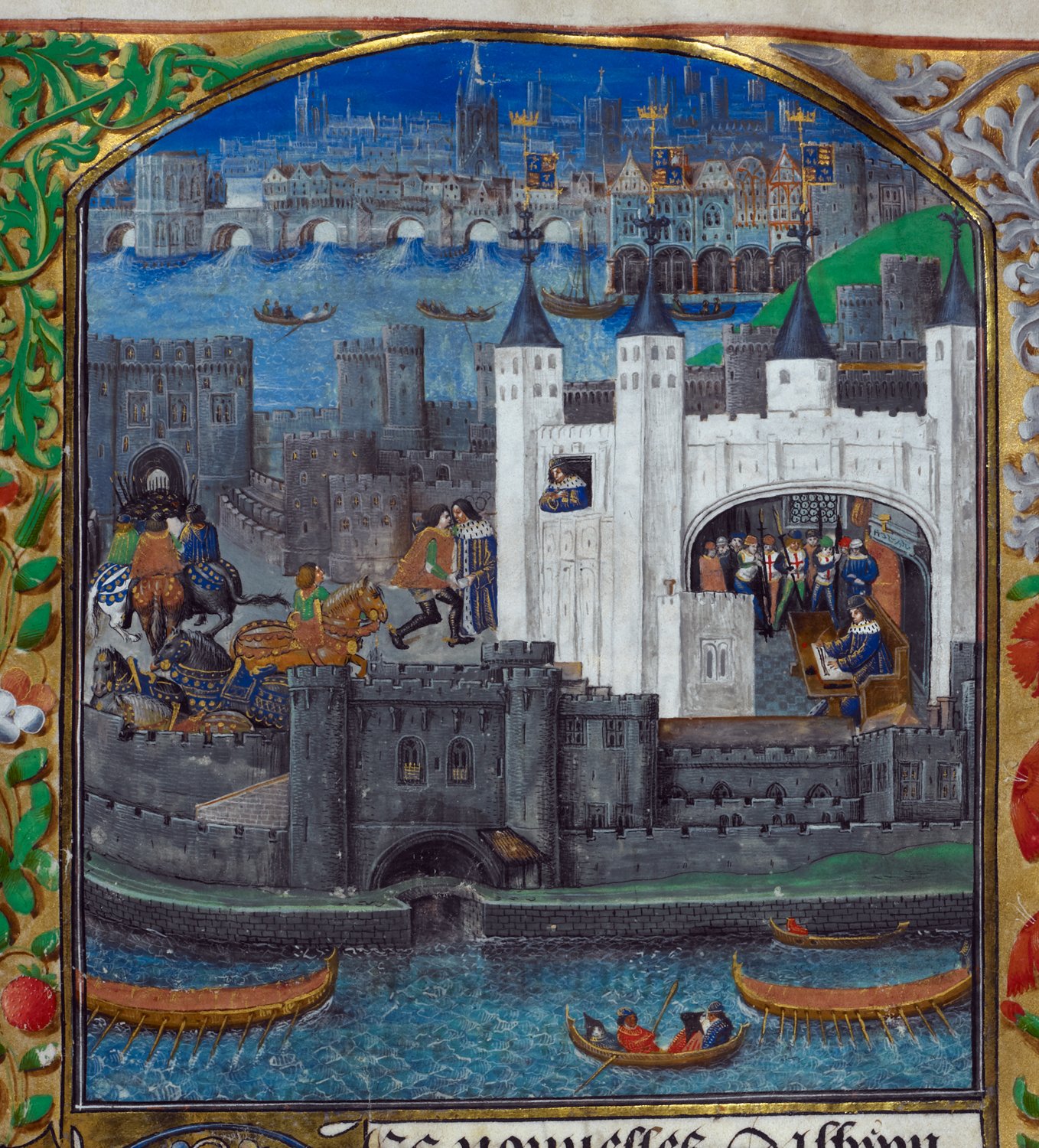
In the early fifteenth century, Charles d’Orléans, an important member of the French aristocracy and prisoner of the English since the battle of Agincourt, addressed the earliest ‘Valentine’ poem to a lover during his imprisoment in the Tower of London:

Je suis desja d’amour tanné,                               I am already sick of love,
Ma tres doulce Valentinée,                                 My very gentle Valentine,
Car pour moi fustes trop tart née,                     Since for me you were born too soon,
Et moy pour vous fus trop tost né.                    And I for you was born too late.
Dieu lui pardoint qui estrené                             God forgives him who has estranged
M’a de vous, pour toute l’année.                       Me from you for the whole year.

Je suis desja d’amour tanné,                              I am already sick of love,
Ma tres doulce Valentinée,                                My very gentle Valentine,
Bien m’estoye suspeconné,                               Well might I have suspected
Qu’auroye telle destinée,                                   That such a destiny,
Ains que passast ceste journée,                       Thus would have happened this day,
Combien qu’Amours l’eust ordonné.                How much that Love would have commanded.

Je suis desja d’amour tanné,                             I am already sick of love,
Ma tres doulce Valentinée.                                My very gentle Valentine.

Charles d'Orléans writing in the Tower of London, British Library Additional MS Royal 16 F II, f. 73

Charles d’Orléans writing in the Tower of London, British Library Additional MS Royal 16 F II, f. 73

The oldest known love letter associated with Valentine’s Day in the English language also survives from the fifteenth century. Preserved in the British Library, it is part of a larger collection of letters written by members of the Paston family of Norfolk. The Valentine letter, written in February 1477, was sent to John Paston by Margery Brews, who swiftly followed it up with another message in reply to Paston’s lost response. In the two documents she tells her ‘welbelouyd’ [well-beloved] John that she has asked her mother to encourage her father to increase her dowry, but that an increase may not be possible, so, if he loves her, he should be prepared to marry her without the pledge of more money. Her remarks about feeling wretched and longing to see John strike a particularly poignant and timeless note, as does her request that ‘non erthely creature safe only your-selfe’ [no earthly creature but yourself] see her letter. Since Margery and John did eventually marry – presumably making Margery the ‘meryest mayden on grounde’ [the happiest maiden on Earth] – her letters are offered below as a testament to the power of love and the emergence of Valentine’s Day in medieval England.

From Margery Brews to Sir John Paston

Vnto my ryght welbelouyd Voluntyn John Paston, squyer, be this bill & delyuered, &c.  Ryght reuerent and wurschypfull and my ryght welebeloued Voluntyne, I recommande me vnto yowe full hertely, desyring to here of yowr welefare, whech I beseche Almyghty God long for to preserve vnto hys plesure and yowr hertys desyre. And yf it please yowe to here of my welefare, I am not in good heele of body ner of herte, nor schall be tyll I here from yowe; For ther wottys no creature what peyn that I endure, And for to be deede I dare it not dyscure. And my lady my moder hath labored the mater to my fadure full delygently, but sche can no more gete then ye knowe of, for the whech God knowyth I am full sory. But yf that ye loffe me, as I tryste verely that ye do, ye will not leffe me therfor; for if that ye hade not halfe the lyvelode that ye hafe, for to do the grettyst labure that any woman on lyve myght, I wold not forsake yowe. And yf ye commande me to kepe me true whereeuer I go iwyse I will do all my myght owe to love and neuer no mo. And yf my freendys say that I do amys, thei schal not me let so for to do, Myn herte me byddys euer more to love yowe truly ouer all erthely thing. And yf thei be neuer so wroth, I tryst it schall be bettur in tyme commyng. No more to yowe at this tyme, but the Holy Trinité hafe yowe in kepyng. And I besech yowe that this bill be not seyn of non erthely creature safe only your-selfe, &c. And thys lettur was indyte at Topcroft wyth full heuy herte, &c. Be your own M. B.

Margery Brews, Valentine Letter, February 1477, London, British Library, MS. Additional 43490, f. 24

Margery Brews, Valentine Letter, February 1477, London, British Library, MS. Additional 43490, f. 24

Margery’s second letter to Sir John Paston

To my ryght welebelouyd cosyn John Paston, swyere, be this lettur + delyueryd, &c.  Ryght wurschypffull and welebelouyd Volentyne, in my moste vmble wyse I recommande me vnto yowe, &c. And hertely I thanke yowe for the letture whech that ye sende me be John Bekurton, wherby I vndyrstonde and knowe that ye be purposyd to com to Topcroft in schorte tyme, and wythowte any erand or mater but only to hafe a conclusyon of the mater betwyx my fadur and yowe. I wolde be most glad of any creature on lyve so that the mater myght growe to effect. And ther as ye say, and ye com and fynde the mater no more toward then ye dyd afortyme ye wold no more put my fadur and my lady my moder to no cost ner besenesse for that cause a good wyle afture, weche causyth myn herte to be full hevy; and yf that ye com and the mater take to non effecte, then schuld I be meche more sory and full of heuynesse. And as for myselfe, I hafe don and vndyrstond in the mater that I can or may, as Good knowyth. And I lete yowe pleynly vndyrstond that my fader wyll no more money parte wyth-all in that behalfe but an c li. [£100] and l [50] marke, whech is ryght far fro the acomplyshment of yowr desyre. Wherfor, yf that ye cowde be content wyth that good and my por persone, I wold be the meryest mayden on grounde. And yf ye thynke not owr-selfe so satysfyed, or that ye myght hafe mech more good, as I hafe vndyrstonde be yowe afor, good, trewe, and lovyng Volentyne, that ye take no such labure vppon yowe as to com more for that mater; but let it passe, and neuer more to be spokyn of, as I may be yowr trewe louer and bedewoman duryng my lyfe. No more vnto yowe at thys tyme, but Almyghty Jesus preserve yowe bothe body and sowle, &c. Be your Voluntyne Mergery Brews

‘I am already sick of love’: Medieval Valentines

The earliest expressions of love linked to St Valentine’s Day are found in the Middle Ages. The most famous is Geoffrey Chaucer’s reference to Valentine’s Day in The Parliament of Fowls, which depicts birds choosing their mates on the feast day: ‘For this was on Seynt Valentynes day, Whan every foul cometh there to chese his make’ [For this was on Saint Valentine’s Day, when every bird comes to choose his mate, lines 309-10]. Less well-known is the fact that several of Chaucer’s contemporaries – Otton de Grandson, John Gower, Sir John Clanvowe, Christine de Pisan and John Lydgate – also wrote about Valentine’s day and helped to further its connection with romantic love.

Venus collecting medieval hearts in Bibliothèque nationale de France, Français 606.

Venus collecting medieval hearts in Bibliothèque nationale de France, Français 606.

In the early fifteenth century, Charles d’Orléans, an important member of the French aristocracy and prisoner of the English since the battle of Agincourt, addressed the earliest ‘Valentine’ poem to a lover during his imprisoment in the Tower of London:

Je suis desja d’amour tanné,                               I am already sick of love,
Ma tres doulce Valentinée,                                 My very gentle Valentine,
Car pour moi fustes trop tart née,                     Since for me you were born too soon,
Et moy pour vous fus trop tost né.                    And I for you was born too late.
Dieu lui pardoint qui estrené                             God forgives him who has estranged
M’a de vous, pour toute l’année.                       Me from you for the whole year.

Je suis desja d’amour tanné,                              I am already sick of love,
Ma tres doulce Valentinée,                                My very gentle Valentine,
Bien m’estoye suspeconné,                               Well might I have suspected
Qu’auroye telle destinée,                                   That such a destiny,
Ains que passast ceste journée,                       Thus would have happened this day,
Combien qu’Amours l’eust ordonné.                How much that Love would have commanded.

Je suis desja d’amour tanné,                             I am already sick of love,
Ma tres doulce Valentinée.                                My very gentle Valentine.

Charles d'Orléans writing in the Tower of London, British Library Additional MS Royal 16 F II, f. 73

Charles d’Orléans writing in the Tower of London, British Library Additional MS Royal 16 F II, f. 73

The oldest known love letter associated with Valentine’s Day in the English language also survives from the fifteenth century. Preserved in the British Library, it is part of a larger collection of letters written by members of the Paston family of Norfolk. The Valentine letter, written in February 1477, was sent to John Paston by Margery Brews, who swiftly followed it up with another message in reply to Paston’s lost response. In the two documents she tells her ‘welbelouyd’ [well-beloved] John that she has asked her mother to encourage her father to increase her dowry, but that an increase may not be possible, so, if he loves her, he should be prepared to marry her without the pledge of more money. Her remarks about feeling wretched and longing to see John strike a particularly poignant and timeless note, as does her request that ‘non erthely creature safe only your-selfe’ [no earthly creature but yourself] see her letter. Since Margery and John did eventually marry – presumably making Margery the ‘meryest mayden on grounde’ [the happiest maiden on Earth] – her letters are offered below as a testament to the power of love and the emergence of Valentine’s Day in medieval England.

From Margery Brews to Sir John Paston

Vnto my ryght welbelouyd Voluntyn John Paston, squyer, be this bill & delyuered, &c.  Ryght reuerent and wurschypfull and my ryght welebeloued Voluntyne, I recommande me vnto yowe full hertely, desyring to here of yowr welefare, whech I beseche Almyghty God long for to preserve vnto hys plesure and yowr hertys desyre. And yf it please yowe to here of my welefare, I am not in good heele of body ner of herte, nor schall be tyll I here from yowe; For ther wottys no creature what peyn that I endure, And for to be deede I dare it not dyscure. And my lady my moder hath labored the mater to my fadure full delygently, but sche can no more gete then ye knowe of, for the whech God knowyth I am full sory. But yf that ye loffe me, as I tryste verely that ye do, ye will not leffe me therfor; for if that ye hade not halfe the lyvelode that ye hafe, for to do the grettyst labure that any woman on lyve myght, I wold not forsake yowe. And yf ye commande me to kepe me true whereeuer I go iwyse I will do all my myght owe to love and neuer no mo. And yf my freendys say that I do amys, thei schal not me let so for to do, Myn herte me byddys euer more to love yowe truly ouer all erthely thing. And yf thei be neuer so wroth, I tryst it schall be bettur in tyme commyng. No more to yowe at this tyme, but the Holy Trinité hafe yowe in kepyng. And I besech yowe that this bill be not seyn of non erthely creature safe only your-selfe, &c. And thys lettur was indyte at Topcroft wyth full heuy herte, &c. Be your own M. B.

Margery Brews, Valentine Letter, February 1477, London, British Library, MS. Additional 43490, f. 24

Margery Brews, Valentine Letter, February 1477, London, British Library, MS. Additional 43490, f. 24

Margery’s second letter to Sir John Paston

To my ryght welebelouyd cosyn John Paston, swyere, be this lettur + delyueryd, &c.  Ryght wurschypffull and welebelouyd Volentyne, in my moste vmble wyse I recommande me vnto yowe, &c. And hertely I thanke yowe for the letture whech that ye sende me be John Bekurton, wherby I vndyrstonde and knowe that ye be purposyd to com to Topcroft in schorte tyme, and wythowte any erand or mater but only to hafe a conclusyon of the mater betwyx my fadur and yowe. I wolde be most glad of any creature on lyve so that the mater myght growe to effect. And ther as ye say, and ye com and fynde the mater no more toward then ye dyd afortyme ye wold no more put my fadur and my lady my moder to no cost ner besenesse for that cause a good wyle afture, weche causyth myn herte to be full hevy; and yf that ye com and the mater take to non effecte, then schuld I be meche more sory and full of heuynesse. And as for myselfe, I hafe don and vndyrstond in the mater that I can or may, as Good knowyth. And I lete yowe pleynly vndyrstond that my fader wyll no more money parte wyth-all in that behalfe but an c li. [£100] and l [50] marke, whech is ryght far fro the acomplyshment of yowr desyre. Wherfor, yf that ye cowde be content wyth that good and my por persone, I wold be the meryest mayden on grounde. And yf ye thynke not owr-selfe so satysfyed, or that ye myght hafe mech more good, as I hafe vndyrstonde be yowe afor, good, trewe, and lovyng Volentyne, that ye take no such labure vppon yowe as to com more for that mater; but let it passe, and neuer more to be spokyn of, as I may be yowr trewe louer and bedewoman duryng my lyfe. No more vnto yowe at thys tyme, but Almyghty Jesus preserve yowe bothe body and sowle, &c. Be your Voluntyne Mergery Brews

Christmas at the Medieval Court

Though Christmas was very different in the Middle Ages, many of the pastimes and activities that we associate with it would have been familiar to medieval people. Feasting, playing games, singing, drinking around a fire, decorating the house with evergreens, and giving gifts, are just some of the traditions enjoyed in the medieval festive season.

The activities depicted at King Arthur’s Christmas court in the famous fourteenth-century romance Sir Gawain and the Green Knight provide a nice insight into the festivities at a late medieval court:

The king was at Camelot at Christmas time, with many a handsome lord, the best of knights, all the noble brotherhood of the Round Table, duly assembled, with revels of fitting splendour and carefree pleasures. There they held tourney on many occasions; these noble knights jousted most gallantly, then rode back to the court to make merry. For there the celebrations went on continuously for fully fifteen days, with all the feasting and merrymaking which could be devised; such sounds of mirth and merriment, glorious to hear, a pleasant uproar by day, dancing at night, nothing but the greatest happiness in halls and chambers among lords and ladies, to their perfect contentment […] While New Year was so young that it had just newly arrived, on the day itself the company was served with redoubled splendour at table. When the king had come with his knights into the hall, the singing of Mass in the chapel having drawn to an end, a loud hubbub was raised there by clerics and others, Christmas was celebrated anew, ‘Noel’ called out again and again. And then nobles came forward to offer good-luck tokens, called aloud ‘New Year gifts’ profffered them in their hands. [translation from W. R. J. Baron’s Sir Gawain and the Green Knight, Manchester University Press]

As this passage illustrates, Christmas in the Middle Ages was a lengthy affair. Preparations and celebrations started well before 25 December, and continued long after. Though peasants returned to work after Epiphany (the twelfth day of Christmas or 6 January), the higher ranks might celebrate for longer, like Arthur’s hosting of tournaments and feasting over fifteen days. Truly extravagant festivities might even extend until Candlemas on 2 February.

A festive feast representing January in the Très Riches Heures of John, duke of Berry (fifteenth century)

A festive feast representing January in the Très Riches Heures of John, duke of Berry (fifteenth century)

The anonymous Gawain-Poet does not describe the individual dishes eaten at Arthur’s feast, but he does evoke the spectacle of a royal banquet, telling us that each course was brought out to ‘the blaring of trumpets’, ‘kettledrums’, and ‘pipes’, and that the dishes contained ‘the richest foods, fresh meat in plenty […] and various stews’; each couple shared ‘twelve dishes, good beer and bright wine’. Food served at a Christmas feast would include roast meats (especially wild boar), fowl, pies, stews, bread, cheese, puddings, ‘sotelties‘ (elaborate decorative dishes designed for entertainment, often with religious or political significance), and mince pies. Unlike the pies familiar to us, medieval mince pies, or shred pies, were bigger, rectangular shaped pastries (known as ‘cofins’), filled with minced meats like pork, eggs, fruit, spices, and fat. No specific recipes for them survive, but the Forme of Cury, a recipe book compiled c. 1390 by Richard II’s master cooks, contains a recipe for ‘chewettes’, which are similar, smaller versions of the medieval mince pie:

Chewettes on Flesch Day. Take the lyre of pork and kerue hit [carve it] al to pecys and hennes therwith and do hit in a panne and frye hit and make a coffyn [pastry] as to a pye smale and do therin and do theruppon yolkes of ayron [eggs] hard, pouder of gyngur and salt, couere hit and fry hit in grece [grease] other bake hit del and serue forth.

Forme of Cury Rylands MS 7

Recipe for Chewettes in The Forme of Cury. Manchester John Rylands Library MS 7

It’s easy to imagine Richard II’s court celebrating Christmas over many days like King Arthur, eating course after course of the dishes described in the Forme of Cury. An account book of 1377 records that twenty-eight oxen and three hundred sheep were eaten at the king’s Christmas feast, and the chronicler John Hardyng, describing the excess of the king’s household in the 1390s, notes that ten thousand people a day attended Richard II’s court and that they were provided with food and drinks by three hundred cooks and servants.

Celebrations in noble and gentry households were much smaller in scale, but nevertheless impressive. A letter from Margaret Paston to her husband John, written on 24 December 1459, includes a list of activities that their neighbour Lady Morley did and did not allow in her household the previous year when she was mourning the loss of her husband:

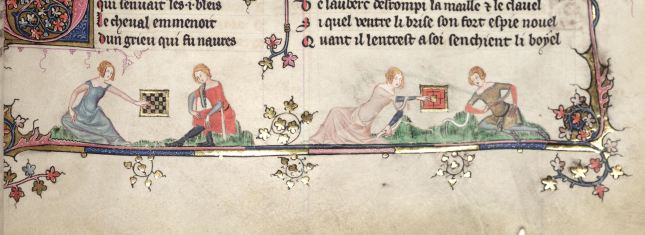
there were no disguisings [masques], nor harping, nor luting, nor singing, nor no loud pastimes, but playing at the tables [board games], and chess, and cards, such activities she gave her folk leave to play and none other [my translation]

Quieter pursuits, such as board games and cards were clearly suitable for a house in mourning, but louder and more spritely Christmas entertainments, such as singing, playing music and watching masques were not.

Board games from Oxford, Bodleian Library MS Bodley 264

Board games from Oxford, Bodleian Library MS Bodley 264

So, as you sit down to eat your Christmas dinner, tuck into a mince pie, sing Christmas carols, or play a board game with your family or friends this year, why not share your knowledge of the medieval Christmas and exchange the medieval Christmas greeting recorded by the Gawain-poet too – ‘Noel!’

Last Things and End of Days

For most of us, tomorrow – 21 December 2012 – will pass like any other Friday before Christmas; finishing work for the holidays, having a few drinks with friends, doing last minute shopping, or wrapping presents, will be the most eventful things we do. Yet some of Earth’s citizens will wait with bated breath to see if predictions associated with the 2012 Phenomenon come true.

Over the last few decades, the idea that the world will end or transform on this day has been advanced by numerous films, documentaries, books, news reports, advertising companies, and internet media. Whatever our individual response to the ‘end of days’ hype, the prophecies about 21 December reflect mankind’s long-standing fascination with Last Things, Apocalypse and Doomsday.

In the Middle Ages, it was commonly believed that 15 signs would herald Christ’s Second Coming and warn of the impending ‘domesday’*, when all men would be judged and sent to heaven or hell. The signs generally include (with some variation): 1) The sea rising; 2) The sea receding; 3) The sea returning to normal; 4) Sea monsters rising up and making hideous noise; 5) All water burning; 6) Trees and plants sweating blood; 7) Earthquakes toppling buildings; 8) Rocks and stones clashing together; 9) Hills and mountains turning to powder; 10) Men leaving their hiding places in fear and silence; 11) The bones of dead men rising; 12) Stars falling to earth from heaven; 13) Death coming for the living; 14) Heaven and Earth burning; 15) Heaven and Earth being made new and the dead rising to be judged.

Linked with St John’s Revelations, and spuriously attributed to Saint Jerome, these portents  appear in texts, such as the Pricke of Conscience, Cursor Mundi, and Legenda Aurea, in the Chester cycle of mystery plays, in sermons like John Mirk’s Festial, and as images in illuminated Books of Hours and Apocalypses. It is possible that many of England’s churches were once adorned with representations of the portents in paintings, carvings and stained glass, but only two examples survive today: a window in All Saints’ Church, North Street, York, and an alabaster altarpiece now in the British Museum.

All Saints Monsters2

Fourth sign of Doomsday: Monsters rise from the oceans and make hideous noise

All Saints Earthquake

Seventh sign of Doomsday: earthquakes. All Saint’s Church tumbles down

All Saints Donors2

The terrified donors of the window watch the end of days at the bottom of the window.

All Saints Death

Death arrives to take ‘childe, man and woman’

The signs were designed to encourage sinners to reflect upon the state of their soul and be mindful that the last days would be ‘cruell’, ‘ferdfull and horrybull’ (Mirk, Advent Sunday Sermon). They frequently accompany descriptions or images of Judgement Day itself, which in Christian iconography is easily recognisable. Christ is often seated on a rainbow (a nod to the rainbow sent to Noah after the deluge), displaying his freshly bleeding wounds, and accompanied by saints and angels, who hold the tools of the crucifixion (the cross, nails, crown of thorns, spear etc.) and trumpet to announce the Judgement. The dead are shown rising from their graves, and heaven and hell appear, with attendant angels and demons.

Judgement Day in British Library MS Yates Thompson 3, f. 32v

Judgement Day in British Library MS Yates Thompson 3, f. 32v

The basis of all judgement scenes is the description of Doomsday found in Matthew 25: 31-46. This account describes what is popularly known as the separation of the sheep and the goats, representative of good and bad souls; the (good) sheep are placed on the right of Christ, or the left of the image being viewed, and the (bad) goats are placed on his left, the right of the image.

Hans Memling's Last Judgement, 1467-71

Hans Memling’s Last Judgement, 1467-71

So, if you notice the earth trembling, sea monsters making a lot of noise, or a red dew on your plants tomorrow, make sure that you’re standing on the right of the man on the rainbow and prepare for doomsday medieval-style.

* ‘dome’ means ‘judgement’ in Middle English

The Parchment Mirror: Reflections of Medieval Life in Literature and Art

Welcome to my occasional blog – The Parchment Mirror.

This is where I will share my fascination with the material remains of the Middle Ages, the manuscripts, literature, art, music, and other precious artefacts, that bring history to life and illuminate medieval culture in thrilling and often unexpected ways.

The inspiration for this blog came from a series of ‘Medieval Entertainment’ tweets that I shared on Twitter a few months ago. I originally envisaged the series comprising approximately ten tweets about the different forms of entertainment available to people in the Middle Ages, but the more I explored the various pastimes illustrated in contemporary manuscripts, the bigger the series grew. I ended the series at fifty-six tweets (across two weeks), but I could have gone on, especially if I’d dedicated more than one tweet to the games that I grouped together under the headings ‘ball games’ and ‘board games’. This blog will allow me to revisit the various forms of entertainment I tweeted about and expand on those activities that my Twitter followers and I found most interesting. It will also allow me to share some of the incredible reflections of the medieval world contained within the literature and manuscripts of the period. Watch this space.

To officially launch my blog, it is only fitting that I should say a few words about the manuscript that inspired the title and featured in my entertainment series: the famous Luttrell Psalter.

The Psalter, otherwise known as British Library Additional MS 42130, is one of the British Library’s greatest treasures; it was made in the first half of the fourteenth century (c. 1325-35) for Sir Geoffrey Luttrell (1276-1345), lord of Irnham in Lincolnshire. Psalters were devotional books that contained the Book of Psalms and other liturgical items, such as calendars, which marked important feast days and often represented medieval life though the ‘Labours of the Month‘. The Luttrell Psalter is particularly special because in addition to containing illustrations typically found in psalters – scenes from the life of Christ and images of the biblical king David, who was believed to be the author of the psalms – the margins of the text are brimming with depictions of daily life in medieval Irnham. From images of low-born peasants tending the fields to striking representations of Geoffrey Luttrell and his noble family feasting and travelling, the psalter offers an exceptional peak at life at both ends of the social spectrum.

Luttrell2As we turn the pages of the psalter, moving through the seasons, we are rewarded with representations of contemporary fashion, rural life, feudal obligation, and fourteenth-century humour. Alongside images of work and play, we also find fantastic grotesques and hybrid creatures drawn straight from the imaginations of the psalter’s artists. Extraordinary drolleries like this commonly inhabit the margins of devotional texts like the Luttrell Psalter and scholars believe that they represent the chaos that lurks beyond the borders of established medieval structures and rule.

As the proud owner of both the British Library facsimile and ebook editions of the psalter, I never tire of looking at the wonderful scenes. They capture my imagination precisely because of the intimate relationship that emerges between the manuscript’s creators and the landscape the artists chose to depict.

To turn the pages of The Luttrell Psalter visit The British Library’s ‘Treasure’ website here. If you fancy time travelling back to fourteenth-century Irnham, watch WAG Screen‘s stunning film based on the Luttrell Psalter below.

To learn more about the psalter’s representation of medieval life see the book that inspired the title of my blog: Michael Camille’s Mirror in Parchment: The Luttrell Psalter and the Making of Medieval England.